Gates of Liberation Gate No. IX Give
Many hands holding painted masks at a previous crossing

A global participatory art movement

Gates of
Liberation


Through art, music, culture, service and community, we create spaces where we remember what is possible within ourselves, through each other, and eventually in the world.

The second gate · Northern Tanzania November 2026

We walk through the gate ourselves

We walk through the Gate ourselves, and then use our collective gifts to create spaces where others can discover their own liberation.

The Caravan — a travelling company of artists, builders and musicians — is the vehicle that carries the Gates from place to place. It is the "we" that walks through first, and it arrives with nothing drawn.

Each Gate is co-designed and built with the people of the place it stands in, using their stories, materials and imagination. Together, over time, these Gates form a living mythology — a shared story authored not by one voice, but by many.

A completed gate standing against an open sky, the whole company gathered beneath it
A gate, raised and crossed · the Caravan beneath it

In one breath

We go to a place. We build a monumental gate with the people there. We gather their art, culture and wisdom into a treasury that belongs to them. We leave a chapter that keeps it. And we keep going, until the gates form a constellation across the world.

The manifesto

One gate is an artwork.
A chain of gates is a movement.

Each passage we open will lead to another we cannot yet imagine.

Every gate begins not with stone or wood or steel, but with an intention, simple and unshakable: to use art to set people free from fear, from separation, and from the invisible structures that tell us who we are allowed to be. Every gate we raise is that intention made visible.

Art is our weapon, the only weapon that disarms. It needs no enemy and wounds no one. It breaks open what has been closed: hearts, borders, habits, histories. We carry no banners of war. We carry tools, songs, colour, and the courage to create in the open.

No gate stands alone. Each one we build together plants the seed of the next, in another land, with another people, carrying the memory of the one before. Tanzania opens the way, and what follows will open the way again. We do not know where it ends, and that is the point.

We come to encounter, never to extract. We do not arrive with finished visions to impose. We arrive to listen, to live alongside, to learn and exchange. The community is not our subject but our co-author, and what we build carries their hands, their stories and their wisdom. It belongs to them as much as to us.

The making is the message. The meals shared, the songs sung, the disagreements resolved, the trust slowly earned: this is the real sculpture, and the gate is only its most visible trace. And a gate is not something to look at. It is something to walk through. Each person who crosses is invited to ask what they are carrying, what they are ready to release, and what world they wish to enter. The art is complete only when someone passes through it.

Wherever a gate rises, art, music, culture and wisdom gather around it. Ceremony returns. Community returns. Art becomes again what it was long before museums: something lived, not merely observed.

No single name owns this movement. Gates of Liberation is held by many: the Guardians who tend it, the Caravan that travels with it, the communities that shape it, and everyone who chooses to join. We build as a cooperative. We share the work, the decisions, the resources and the fruits, and power flows in circles, not pyramids.

We do not export one definition of freedom. Liberation means something different to every person and every people, and each gate is a place where those many freedoms can meet and stand side by side. We honour the land that holds each one. Earth, wind, light and time are our collaborators, not our backdrop, and what we leave behind should heal and serve those who remain long after we move on.

Liberation is not a destination.
It is a passage.

Gate No. IX opens in Tanzania.
Where will the next one lead?

The form

What a gate is

The gate is among the oldest human symbols — the boundary between outside and inside, ordinary and sacred, who we were and who we are becoming. We make that threshold literal and monumental, then invite people to cross it with intention.

A Gate is a passage you cross, not a monument you observe. It carries no fixed doctrine. Each one is a chapter contributed by a different community in its own voice, and no single author owns the story.

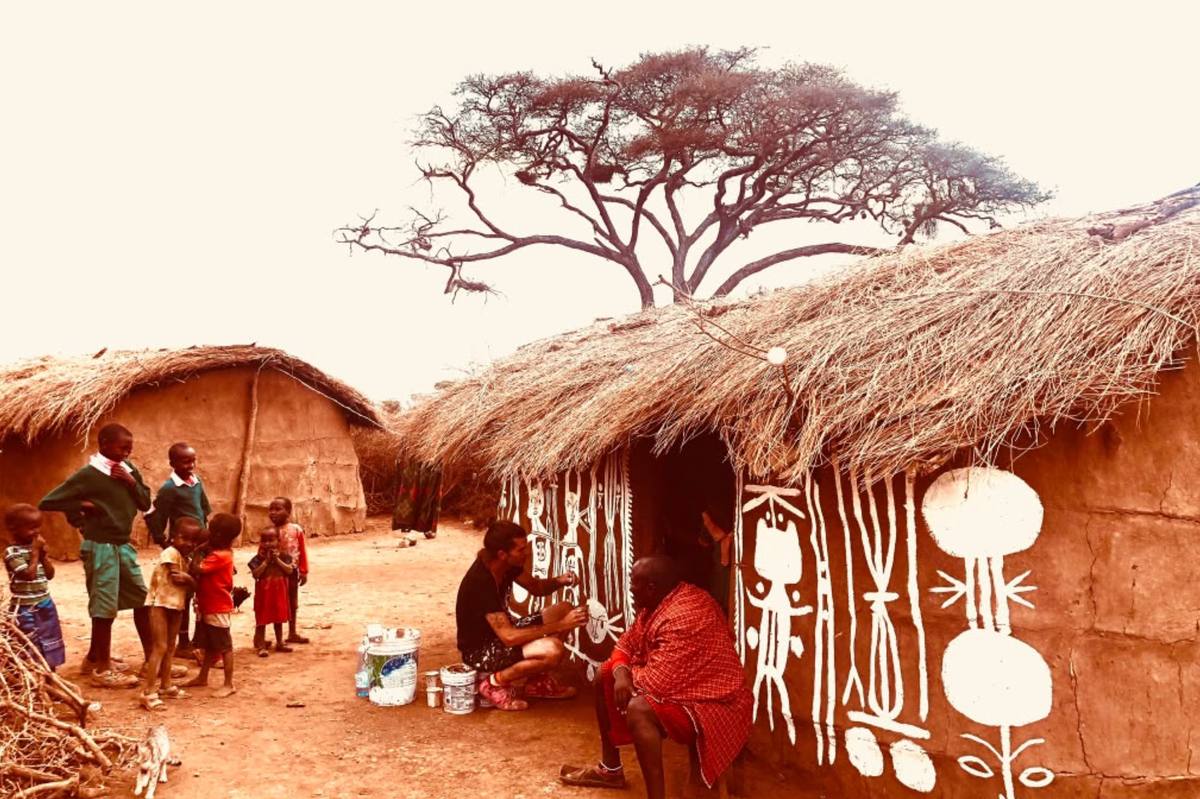
A painted doorway in a Maasai homestead
A threshold, painted by many hands

The method

How a gate is made

One arc, entirely its own each time. The method is deliberately repeatable — it works anywhere a community says yes.

01

Invitation

A relationship, and freely given consent, on the community's terms.

02

Listening

Stories, histories, materials and meanings. The gate emerges from the place.

03

Co-design

Artists and community design together, from local imagery and craft.

04

Construction

Built over an intensive week by many hands, skills shared both ways.

05

Activation

A ceremony of crossing brings the gate to life.

06

Legacy

Gate, chapter and skills handed to the community as its own.

The artist at work on a homestead wall beneath an acacia

What stays

Every gate opens a chapter

A gate is not an event that ends when the Caravan leaves. The community that builds it keeps it, gathers at it, and adds to it — regular encounters at the threshold, culture brought together, a fixed point on the land where people return.

A place

A threshold that stands in the landscape, made by the hands of the people who live beside it.

A gathering

People who return to it — at the turning of a season, or simply because it is there.

A treasury

Art, culture and wisdom, gathered at the threshold and held by the community itself.

The treasury

It belongs to them

Each gate gathers the art, culture and wisdom of the place into a treasury that belongs to the community that authored it — a living mythology of freedom, held by the people who made it.

The people who build it share in it directly: participants are paid for their craft and their work, funded through philanthropy and room bookings.

The principles

Gathered, not brought

We come to listen for the principles that have kept a people free, and gather them as we go, rather than bringing a manifesto of our own. Radical self-reliance looks like one thing in Brittany and another in Momella. Leave no trace, in some places, is a grandmother at the table.

How this is held

Given, not sold

Every gate is free at the point of experience, owned by its community, and kept clear of advertising. Every contribution is anonymous — no name on the threshold, no plaque, no tier, no credit line. What is given disappears into the work, which is the only way a gift stays a gift.

Gates of Liberation is being formed as a cooperative, held by its members. Not owned by a founder, a patron or a foundation, but held in common by the people who build, carry and steward the gates — in the spirit of collaboration the work is made of.

501(c)(3) fiscal sponsorship through Coven Art.

The horizon

One gate at a time

Gate No. IX rises in northern Tanzania in November 2026, with the Maasai of Momella. What is decided there about how a gate is made, and who it belongs to, carries into every one that follows.

Maasai women before a painted wall in Momella

Gate No. IX · Momella, Northern Tanzania

Protectors of the Invisible

24 November — 1 December 2026. Thirty participants live alongside a Maasai community and raise a monumental gate together.

See Gate No. IX